
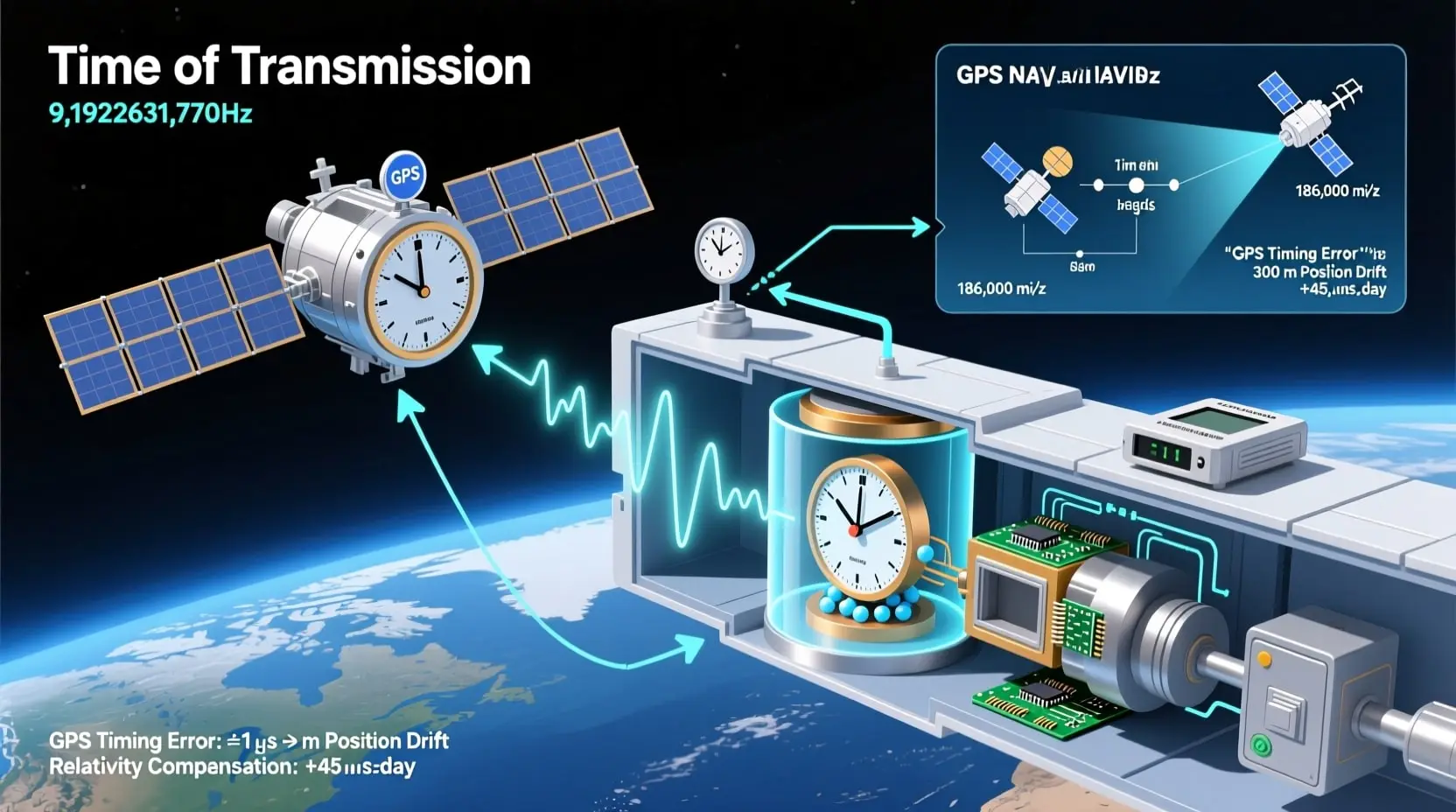
The Global Positioning System has revolutionized how we navigate our world, from driving across cities to guiding aircraft across continents. At the heart of this remarkable technology lies an incredibly precise timekeeping mechanism that makes accurate positioning possible. Understanding “how do atomic clocks work”is essential to appreciating the sophisticated engineering behind GPS navigation. These extraordinary devices measure time with such precision that they lose only one second every 100 million years, making them the backbone of satellite-based positioning systems worldwide.
The Fundamental Science Behind Atomic Timekeeping
Atomic clocks operate on a very different principle than clock mechanisms or quartz clocks. The atomic clock does not depend on a pendulum swinging or a well-defined vibrating crystal. Instead, it uses the natural oscillation frequency of an atom. Most cesium or rubidium atoms, which are used in GPS satellites, oscillate with an extremely stable frequency when subjected to microwave radiation:
Cesium atoms oscillate 9,192,631,770 times at a frequency that is so stable that it has become the international definition of one second. This atomic resonance gives a truly stable reference, which does not change under any conditions in the environment: temperature, pressure, or any other influence that a traditional clock might be subjected to.
How Do Atomic Clocks Work Within GPS Satellites?
Atomic clocks on board the GPS satellites orbiting Earth emit steady signals with high precision. The chain begins when cesium or rubidium atoms are heated and set free into a vacuum chamber. The atoms pass through a magnetic field that segregates them depending on their energy states.
Microwave signals are then applied to the atoms at specific frequencies. Once the frequency meets the natural resonance of the atoms, they will change energy state. Detectors monitor the transitions, and feedback loops adjust the microwave frequency to remain perfectly synchronized with atomic oscillations. The self-correcting nature ensures stunningly precise long-term stability.
The Critical Role of Precise Timing in GPS Navigation
GPS positioning is founded upon the precise measurement of the timing of radio signals traveling from the satellites. Since the satellite signals travel at the speed of light, around 186,000 miles per second, even a slight error in timing incurs huge positional errors.
An error of a single microsecond in the clock results in a GPS position error of approximately 300 m. Thus, multiple atomic clocks are installed in each satellite, usually three or four per satellite, in order to allow redundancy and cross-checking to ensure the reliability of the system.
Signal Transmission and Distance Calculation
They continuously broadcast signals with their locations and times of transmission written in an exact manner. Upon acquiring signals from several satellites, your GPS receiver calculates how much time has elapsed between transmission and reception.
The time difference, multiplied by the speed of light, indicates how far each satellite is from the receiver. Once the receiver establishes the distance from at least four satellites, the precise three-dimensional position on earth can be calculated in latitude, longitude, and altitude.
Overcoming Relativistic Effects
The atomic clocks used for GPS encounter some very interesting problems with respect to relativity. Here comes Einstein: For the satellites, the clocks would be experiencing time dilation from the high speeds of their orbits, marking them as running a little slowly in respect to their counterparts on the surface of the earth. The weaker gravitational field at the altitude of orbit would serve to speed the clocks up.
If engineers were to disregard these relativistic effects, positioning errors would accumulate to about 10 kilometers a day. Finally, the atomic clocks on board the GPS satellites are adjusted before they are launched so as to cancel out these predictable relativistic inconsistencies.
Ground Control and System Synchronization
In fact, GPS consists of ground monitoring stations that track satellite signals and constantly compare onboard atomic clocks to master clocks located at the U.S. Naval Observatory. When any timing drift is noticed, the facilities make such adjustments before uploading them to the satellites.
This continuous monitoring guarantees that all satellites are synchronized and have consistent, reliable positioning information provided to the users around the world on a 24/7 basis.
Applications Beyond Basic Navigation
So, these GPS atomic clocks, you see, provide precise timing far beyond navigation. GPS timing is used for stamping transactions in banks, telecom networks coordinate their operation utilizing these signals, and power grids use GPS timings to distribute energy over broad networks.
Scientific research, emergency service, and agriculture, among others, rely upon this technology. Atomic clock accuracy is now a key pillar of modern infrastructure.
Conclusion
Incredible engineering has gone into defining how do atomic clocks work, an essential component that makes GPS navigation perhaps one of mankind’s glorious achievements in technology. Location can be resolved anywhere on Earth to within a few meters once we grasp how atomic clocks function. The lowest elements required for such accuracy work together from the quantum behavior of cesium atoms through relativistic adjustments for orbiting satellites, which we often take for granted. Atomic clocks continue to evolve with technology, promising even better accuracy for navigation systems in the future and applications we cannot yet imagine.
Leave a Reply