
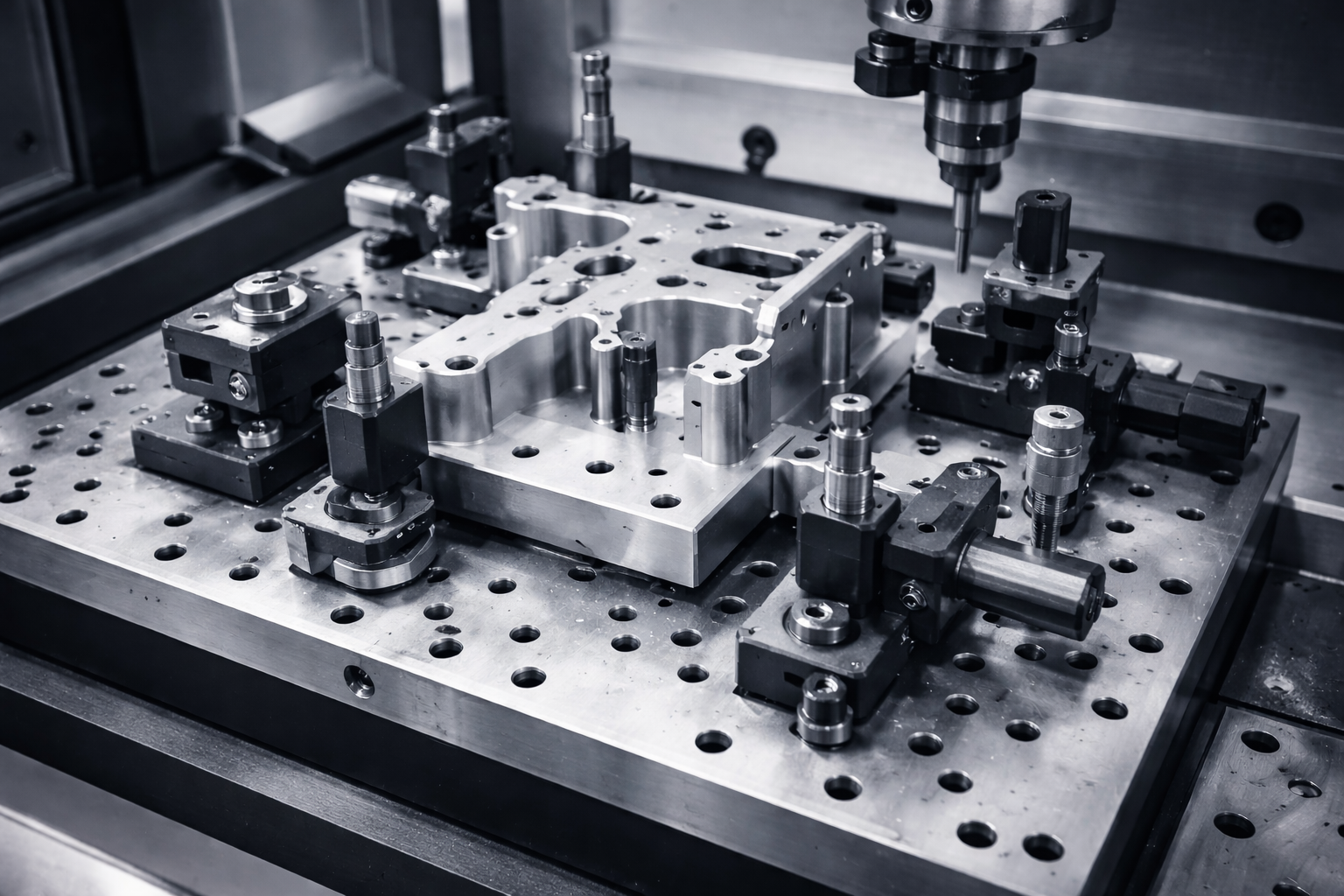
CNC machining enables manufacturers to produce complex parts with speed, accuracy, and repeatability, but these advantages depend heavily on how well a workpiece is positioned and supported during machining. Even the most advanced CNC equipment cannot deliver consistent results without stable and repeatable workholding solutions. This is why jigs and fixtures remain essential in precision manufacturing, ensuring that components maintain correct alignment throughout cutting, drilling, or milling operations while minimizing human error and variation.
Modern industries rely on CNC machining to meet tight tolerances, demanding surface finishes, and strict quality standards. From low-volume prototypes to large-scale production, precision workholding systems play a foundational role in maintaining dimensional integrity, improving machining efficiency, and supporting consistent output across batches and machines.
Understanding the Function of Jigs and Fixtures in CNC Machining
Differences Between Jigs and Fixtures in Practical Use
Jigs and fixtures are both classified as workholding tools, but they serve distinct purposes within machining environments. A jig primarily guides the cutting tool while holding the workpiece in a fixed position, making it suitable for repetitive drilling or tapping operations. Fixtures, in contrast, are designed to securely locate and clamp the workpiece while the CNC machine executes pre-programmed tool paths, which is why fixtures are more commonly used in CNC machining applications. In precision manufacturing, fixture systems rely on precision locating devices such as dowel pins, reference surfaces, and datum features to establish consistent part orientation. This repeatability ensures that each machining cycle starts from the same reference point, allowing CNC programs to perform reliably without constant manual adjustments. Accurate workholding reduces setup variability and supports higher production consistency.
Contribution to Accuracy, Stability, and Process Control
Effective machining support tooling directly influences machining accuracy and stability. A well-designed fixture resists cutting forces, minimizes vibration, and prevents unwanted part movement during machining operations. This stability helps maintain tight tolerances, improves surface finish quality, and reduces tool wear over time. By maintaining consistent part positioning across multiple setups, fixtures also support better process control. Operators can run longer production cycles with confidence, knowing that dimensional variation will remain within acceptable limits. This level of control is especially valuable in precision manufacturing environments where even small deviations can lead to assembly issues or functional failures.
Core Principles of CNC Fixture Design
Structural Design and Material Selection
Successful CNC fixture design begins with structural integrity and appropriate material selection. Fixtures must be rigid enough to withstand machining forces without deformation while remaining lightweight enough for efficient handling and setup. Common materials include hardened steel for high-load applications and aluminum alloys for fixtures requiring lower weight and faster changeovers. Thermal behavior is another critical consideration, particularly for long machining cycles. Materials with predictable thermal expansion characteristics help maintain dimensional accuracy as temperatures fluctuate during operation. By balancing strength, weight, and thermal stability, designers create fixture systems that perform consistently across varied machining conditions.
Locating and Clamping Strategies
Accurate locating and clamping strategies ensure that workpieces remain secure without distortion. Locators define the part’s exact position, while clamps apply sufficient force to hold the component in place without inducing stress. Poorly applied clamping pressure can deform thin-walled parts or introduce dimensional inaccuracies, making careful force distribution essential.
Key considerations often include:
-
Clear tool access for multi-axis machining operations
-
Balanced clamping forces to avoid part distortion
-
Repeatable locating features for consistent setups
These principles allow fixtures to support complex machining tasks while maintaining reliability and precision.
Industry Applications Requiring High-Precision Workholding
Aerospace, Medical, and Automotive Manufacturing
Industries such as aerospace, medical, and automotive manufacturing demand extremely high levels of accuracy and repeatability. Aerospace components must meet strict safety and performance standards, requiring fixtures that maintain exact alignment across multiple machining stages. Medical device manufacturing relies on precise workholding to achieve tight tolerances and high-quality surface finishes necessary for biocompatibility. Automotive production benefits from fixtures designed for both precision and efficiency, supporting high-volume manufacturing without sacrificing consistency. In these sectors, machining support tooling enables manufacturers to meet regulatory requirements while maintaining predictable production schedules.
Electronics, Robotics, and Advanced Manufacturing
Electronics and robotics manufacturing involve small, complex components that require stable yet delicate workholding solutions. CNC fixture design for these applications often focuses on precision locating devices capable of supporting micro-machining operations where minimal movement can affect functionality. In advanced manufacturing environments, fixtures increasingly support flexible production systems. Modular designs allow quick reconfiguration for different parts, helping manufacturers adapt to shorter product life cycles and frequent design changes. This adaptability is critical in technology-driven industries where innovation and speed are competitive advantages.
Selecting a Reliable Partner for Custom Fixture Solutions
Engineering Expertise and Manufacturing Insight
Choosing a supplier with strong engineering capabilities ensures that fixture systems align with both design intent and real-world machining conditions. Experienced partners understand how cutting forces, material properties, and tool paths interact during CNC operations, allowing them to design fixtures that enhance accuracy without unnecessary complexity.
Effective collaboration between engineering and production teams leads to solutions that reduce setup time, minimize errors, and improve overall process efficiency. Clear communication and technical understanding are essential for translating functional requirements into practical workholding systems.
Quality Assurance and Long-Term Reliability
Long-term fixture performance depends on rigorous quality control and validation processes. Reliable suppliers inspect and test fixtures before deployment to confirm accuracy, durability, and repeatability. This approach reduces the risk of production disruptions and supports consistent output over extended production runs.
Important evaluation factors often include:
-
Inspection and measurement capabilities
-
Documentation and traceability practices
-
Ability to support future modifications or scaling needs
These elements contribute to stable manufacturing operations and long-term confidence in production quality.
Conclusion
According to Wikipedia’s explanation of numerical control machining modern manufacturing relies on precise, repeatable systems to achieve consistent production outcomes. Throughout this article, we examined how structured workholding solutions support CNC machining accuracy by providing stability, repeatability, and reliable part positioning across diverse manufacturing environments. From foundational design principles to industry-specific applications, effective workholding remains a critical component of precision manufacturing.
By prioritizing thoughtful design, suitable material selection, and proven engineering practices, manufacturers can maintain dimensional integrity while improving process efficiency. As highlighted in Google’s manufacturing technology resources the continued evolution of automation and digital workflows makes dependable workholding strategies an essential element of modern CNC machining systems.
Leave a Reply