Doji Candlestick Pattern: A Simple Guide for Traders
Ever watched a candle flicker and noticed how unpredictable it can be? The stock market works in a similar way. Traders rely on patterns to predict market direction, and one of the most talked-about ones is the doji candlestick pattern — a small yet powerful signal that tells a story of indecision between buyers and sellers.
In this article, we’ll break down exactly what a doji candlestick is, how it forms, what different types exist, and how you can use it effectively — even if you’re new to trading or just exploring a technical analysis course.
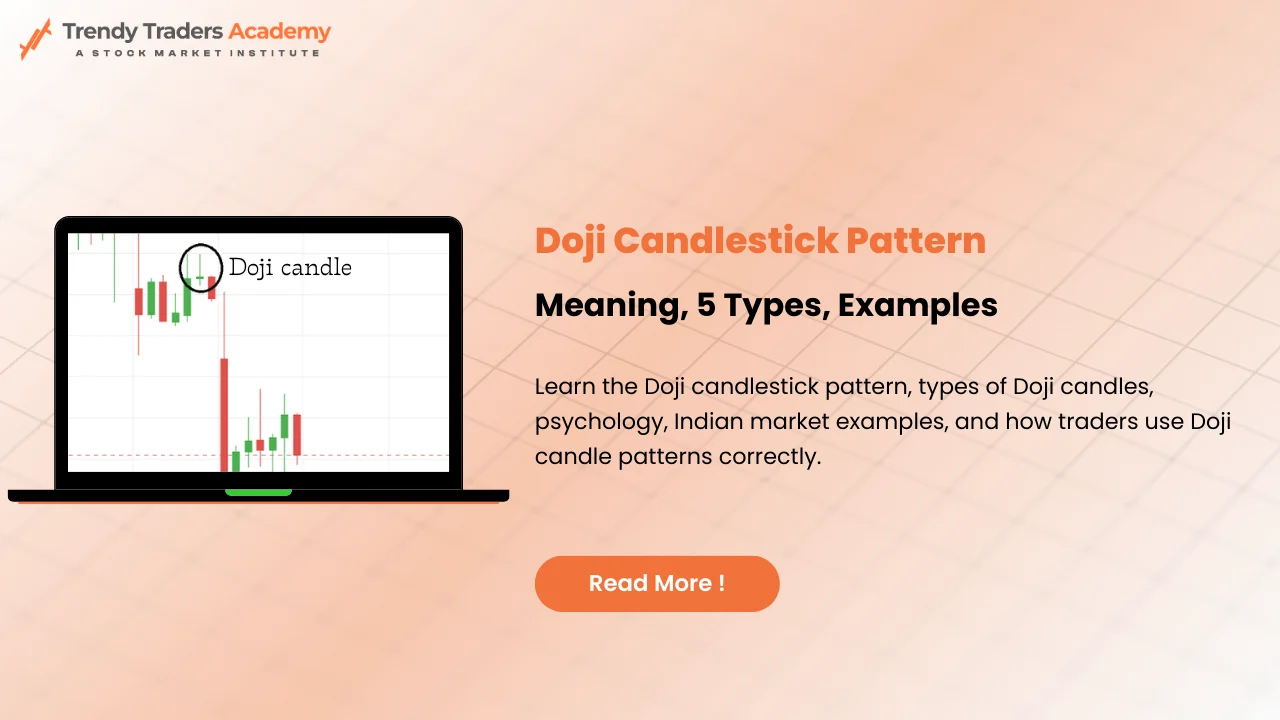
Learn the meaning of the doji candlestick pattern, types of doji candlestick, and how to use them in trading from this technical analysis course-style guide.
What Is a Doji Candlestick Pattern?
A doji candlestick pattern represents a moment of indecision in the market. It forms when the opening and closing prices of an asset are almost identical, creating a shape that looks like a plus sign (+) or a cross.
Imagine a tug-of-war between bulls and bears where no one wins — that’s your doji. It doesn’t scream “buy” or “sell” but whispers, “something might change soon.”
Anatomy of a Doji Candle
Every candlestick has four key parts:
- Open: The price when the trading period starts
- Close: The price when the period ends
- High: The highest point the price reached
- Low: The lowest point it dipped
In a doji, the open and close are virtually the same. The wicks (or shadows) above and below show how far prices moved, but in the end, neither buyers nor sellers took full control.
Why Traders Care About Doji Patterns
Traders see the doji candlestick as a sign of uncertainty — a pause before the market decides its next move.
It’s especially powerful when appearing after a strong uptrend or downtrend, signaling a potential reversal. In plain language — it’s like the market taking a deep breath before making its next big step.
Types of Doji Candlestick Patterns
There are several variations of the doji pattern, each telling a slightly different story about market emotions. Understanding them can help you read the chart more accurately. The main types include:
- Classic Doji
- Dragonfly Doji
- Gravestone Doji
- Long-Legged Doji
- Four-Price Doji
Let’s explore each one.
The Classic Doji
The classic doji looks like a simple cross — small or non-existent body, equal-length wicks.
It tells traders that buyers and sellers fought hard but ended in a draw. When this candle appears after a trend, it might hint at a slowdown or reversal.
The Dragonfly Doji
The dragonfly doji looks like a “T” — it has a long lower shadow and little to no upper wick.
It shows that sellers dominated early but lost to buyers by the close. When it forms at the bottom of a downtrend, it often signals a bullish reversal — like a phoenix rising from the ashes.
The Gravestone Doji
As the name suggests, the gravestone doji reminds traders of a grave marker – flat at the bottom, with a tall upper wick.
It forms when buyers push prices up but fail to maintain them, allowing sellers to pull it back down. This usually indicates a bearish reversal after an uptrend.
The Long-Legged Doji
The long-legged doji has long wicks on both ends, showing extreme indecision. Both buyers and sellers pushed the price around massively, but neither won.
Such a candle suggests heightened market emotion or volatility — like two boxers equally matched in a tied round.
The Four-Price Doji
This rare pattern shows up as a straight horizontal line because the open, close, high, and low are all the same.
It reflects a market completely frozen — no battle, just silence. You might see it in low-volume markets or brief pauses between movements.
How to Read a Doji in a Chart
Reading a doji candlestick correctly requires context.
- If it appears after a long bullish run, it may hint at buyer exhaustion and a possible downturn.
- If it shows up after a bearish fall, it could signal seller fatigue and a potential rise.
- When seen in sideways or range markets, it merely indicates neutral momentum.
Never read a doji alone — pair it with other indicators or chart patterns.
Common Mistakes Traders Make
Many beginners assume every doji means an immediate reversal. That’s rarely true.
Here are common misinterpretations:
- Trading without confirmation from volume or trend indicators.
- Ignoring market news that influences sudden moves.
- Applying doji analysis the same way on different timeframes.
Remember, every doji needs supporting evidence before acting.
How to Trade Using the Doji Candlestick Pattern
Here’s a simple 3-step method:
- Identify the trend: Determine if the market is overbought or oversold.
- Spot the doji: Find the candle with a small body and visible shadows.
- Wait for confirmation: The next few candles should confirm the change — green (bullish) or red (bearish).
For example, if a dragonfly doji forms after a steady downtrend and the next candle is bullish, it may suggest a buy entry.
Doji with Support and Resistance Levels
Pairing doji patterns with support and resistance zones greatly increases accuracy.
If a gravestone doji appears near resistance, it strengthens the case for a downward reversal. Likewise, a dragonfly doji forming at support adds conviction for a potential upward reversal.
This is a technique often explained in a technical analysis course, where combining multiple signals leads to smarter trading decisions.
Doji Candlesticks in Technical Analysis Courses
In every professional technical analysis course, the doji is one of the earliest patterns taught. That’s because it reveals market psychology.
Courses often teach:
- How traders interpret indecision signals.
- When to trust a doji pattern in price action.
- How to use it with RSI, MACD, or Bollinger Bands.
Learning this pattern helps traders make confident, data-backed decisions rather than emotional guesses.
Final Thoughts
The doji candlestick pattern might be small, but its meaning packs a punch. It’s like a pause button on the market chart — a signal that says, “Wait, something is changing.”
By combining doji candlesticks with other technical indicators and chart patterns, you’ll be better equipped to read the market’s behavior — not blindly, but with insight and confidence.
FAQs
- What does a doji candlestick tell traders?
A doji indicates indecision in the market, showing that buyers and sellers are equally strong. It often signals a potential reversal. - Is a doji candlestick always a reversal signal?
No. A doji suggests indecision but not always a reversal. It must be confirmed by following candles and other technical indicators. - How can beginners use doji candlesticks effectively?
Learn to identify them correctly and always confirm with trend analysis, volume, or resistance/support levels before making a trade. - Which doji pattern is most reliable?
The dragonfly and gravestone doji are considered the most significant reversal signals when confirmed by trend direction. - Can I master doji analysis without a technical analysis course?
Yes, but enrolling in a technical analysis course helps you understand broader context, combinations, and strategies that make you more accurate.
Leave a Reply